How strange to read commentary on the on-going confrontations between the U.S. and North Korea and Iran concerning nuclear technology. What I find unbelievable is that I've yet to read anyone who questions the underlying premise, which is that some countries have the right to certain technology while others don't. We're being resourceful when we develop something like germ warfare or suitcase nukes, but they're "renegade nations" who cannot be trusted with such things. Can someone explain the moral argument behind this? I don't think there is one.
Is there any doubt that the first Europeans in the New World did their best to keep the secret of their "fire-sticks" from the native Americans? The inventors of dynamite were surely jealous of their explosive new toy. Nobody wants potential enemies to have access to our latest weaponry, but sooner or later, they get it. Such is the nature of technological drift.
So we can assume, with close to 100% certainty that Iran, North Korea and anyone else willing to invest a bit of time and money will eventually have nuclear bombs if they want them. That cat got out of the bag decades ago. So why are we still trying to control something that is already way beyond our control?
Because the only other option is to shift to a new paradigm for international relations. This new paradigm will be characterized by global MAD (mutually-assured destruction). This time, it's not just a couple of countries who are capable of wiping each other out, it's pretty much everyone. We're in the transition from living in a town where only the sheriff and a couple of other prominent thugs have guns, to one of those Pakistani villages where absolutely everyone over the age of 7 is walking around with an AK-47. A very different situation, to say the least. And it's not a situation that bodes well for the sheriff, if he keeps ignoring the fact that he's not the only one with a gun any more.
Friday, July 07, 2006


Wednesday, June 28, 2006
Cops = Robbers
From a recent Frank Rich column in the NY Times:
Right, narrative is everything. Whatever your "facts" happen to be, if you have control over the narrative in which they are embedded, you control their import.
I'll tell you why the Democrats are so mysteriously unable to beat the Republicans, who couldn't be more vulnerable if they were cleaning drains in a prison shower: they have no story. They cannot have a story to rival the Repub's story, cause as repulsive as it is, the Repub's story is based on truth.
Here are the two party's narratives:
Republicans: We're rich bastards who don't give a damn about the poor or the common good, cause we can afford to buy our way out of the mess our single-minded pursuit of wealth and power creates (we'll filter our private air and water, hire private security firms, build walled communities, pay for private medical care, etc). We pretend to be Christians in order to give us some popular base, but all we really care about is power and money. If you support us, there's a chance you might get some of the booty we control.
Democrats: We're rich bastards who do sorta care about the poor and the common good, but not enough to get unruly when the other party rapes and pillages the environment, the Constitution or the above-mentioned working class. Truth is, we can afford to buy our own protection as well, so the plight of the working class is a bit of an abstraction to us, but it's an abstraction we find somewhat compelling. In other words, we're full of shit. Supporting us will get you nothing but well-intentioned platitudes.
This is why Clinton was compelling but Kerry wasn't. Clinton came from an alcoholic trailer park, while Kerry lives in castles. Without a credible hope of understanding poverty, no Democratic candidate has a chance.
Say what you will about the Repubs, their message makes sense. It has conviction. They're swashbuckling pirates with knives in their belts.
The Democrats are what? War heroes without the balls to directly confront a sniveling shithead like GWB? If John Kerry is so fucking brave, why didn't he throw that shit in GWB's face in the debates? Why did he defer to Bush's accusations without mentioning Bush's avoidance of national service, his drug use, his business failures, his father having bought him every opportunity he's ever had? Why didn't he go to the mat over the vote-stealing in Florida and Ohio?
I'll tell you why, because the Democrats are merely "representatives" of the working-class, while the Republicans are actual members of the class they represent.
That's the difference; the Republicans represent their friends and families while the Democrats represent people who work for them. And really, who's gonna risk their career and comfy life on an abstraction or an easily-replaced employee?
At this point, there's as much difference between the two American political parties as there is between cops and criminals in a place like Nigeria. In other words, none beyond the uniforms. Both of them are criminals, but they enact a simulacrum of struggle to distract the victims of their corrupt game.
What's most impressive about Mr. Rove, however, is not his ruthlessness, it's his unshakable faith in the power of a story. The story he's stuck with, Iraq, is a loser, but he knows it won't lose at the polls if there's no story to counter it.
And so he tells it over and over, confident that the Democrats won't tell their own. And they don't — whether about Iraq or much else.
The question for the Democrats is less whether they tilt left, right or center, than whether they can find a stirring narrative that defines their views, not just the Republicans'.
What's needed, wrote Michael Tomasky in an influential American Prospect essay last fall, is a "big-picture case based on core principles.
Right, narrative is everything. Whatever your "facts" happen to be, if you have control over the narrative in which they are embedded, you control their import.
I'll tell you why the Democrats are so mysteriously unable to beat the Republicans, who couldn't be more vulnerable if they were cleaning drains in a prison shower: they have no story. They cannot have a story to rival the Repub's story, cause as repulsive as it is, the Repub's story is based on truth.
Here are the two party's narratives:
Republicans: We're rich bastards who don't give a damn about the poor or the common good, cause we can afford to buy our way out of the mess our single-minded pursuit of wealth and power creates (we'll filter our private air and water, hire private security firms, build walled communities, pay for private medical care, etc). We pretend to be Christians in order to give us some popular base, but all we really care about is power and money. If you support us, there's a chance you might get some of the booty we control.
Democrats: We're rich bastards who do sorta care about the poor and the common good, but not enough to get unruly when the other party rapes and pillages the environment, the Constitution or the above-mentioned working class. Truth is, we can afford to buy our own protection as well, so the plight of the working class is a bit of an abstraction to us, but it's an abstraction we find somewhat compelling. In other words, we're full of shit. Supporting us will get you nothing but well-intentioned platitudes.
This is why Clinton was compelling but Kerry wasn't. Clinton came from an alcoholic trailer park, while Kerry lives in castles. Without a credible hope of understanding poverty, no Democratic candidate has a chance.
Say what you will about the Repubs, their message makes sense. It has conviction. They're swashbuckling pirates with knives in their belts.
The Democrats are what? War heroes without the balls to directly confront a sniveling shithead like GWB? If John Kerry is so fucking brave, why didn't he throw that shit in GWB's face in the debates? Why did he defer to Bush's accusations without mentioning Bush's avoidance of national service, his drug use, his business failures, his father having bought him every opportunity he's ever had? Why didn't he go to the mat over the vote-stealing in Florida and Ohio?
I'll tell you why, because the Democrats are merely "representatives" of the working-class, while the Republicans are actual members of the class they represent.
That's the difference; the Republicans represent their friends and families while the Democrats represent people who work for them. And really, who's gonna risk their career and comfy life on an abstraction or an easily-replaced employee?
At this point, there's as much difference between the two American political parties as there is between cops and criminals in a place like Nigeria. In other words, none beyond the uniforms. Both of them are criminals, but they enact a simulacrum of struggle to distract the victims of their corrupt game.
Saturday, June 24, 2006
Vonnegut on Bush
From Vonnegut's recently-published memoires:
Running the Country as TV Entertainment
"Do unto others what you would have them do unto you." A lot of people think Jesus said that, because it is so much the sort of thing Jesus liked to say.
But it was actually said by Confucius, a Chinese philosopher, five hundred years before there was that greatest and most humane of human beings, named Jesus Christ.
The Chinese also gave us, via Marco Polo, pasta and the formula for gunpowder. The Chinese were so dumb they only used gunpowder for fireworks. And everybody was so dumb back then that nobody in either hemisphere even knew that there was another one.
We've sure come a long way since then. Sometimes I wish we hadn't. I hate H-bombs and the Jerry Springer Show
But back to people like Confucius and Jesus and my son the doctor, Mark, each of whom have said in their own way how we could behave more humanely and maybe make the world a less painful place. One of my favourite humans is Eugene Debs, from Terre Haute in my native state of Indiana.
Get a load of this. Eugene Debs, who died back in 1926, when I was not yet four, ran five times as the Socialist party candidate for president, winning 900,000 votes, almost 6 percent of the popular vote, in 1912, if you can imagine such a ballot. He had this to say while campaigning:
"As long as there is a lower class, I am in it.
"As long as there is a criminal element, I am of it.
"As long as there is a soul in prison, I am not free."
Doesn't anything socialistic make you want to throw up? Like great public schools, or health insurance for all?
When you get out of bed each morning, with the roosters crowing, wouldn't you like to say. "As long as there is a lower class, I am in it. As long as there is a criminal element, I am of it. As long as there is a soul in prison, I am not free."
How about Jesus' Sermon on the Mount, the Beatitudes?
Blessed are the meek, for they shall inherit the Earth.
Blessed are the merciful, for they shall obtain mercy.
Blessed are the peacemakers, for they shall be called the children of God.
And so on.
Not exactly planks in a Republican platform. Not exactly George W Bush, Dick Cheney, or Donald Rumsfeld stuff.
For some reason, the most vocal Christians among us never mention the Beatitudes. But, often with tears in their eyes, they demand that the Ten Commandments be posted in public buildings.
And of course that's Moses, not Jesus. I haven't heard one of them demand that the Sermon on the Mount, the Beatitudes, be posted anywhere.
"Blessed are the merciful" in a courtroom? "Blessed are the peacemakers" in the Pentagon? Give me a break!
It so happens that idealism enough for anyone is not made of perfumed pink clouds. It is the law! It is the US Constitution.
But I myself feel that our country, for whose Constitution I fought in a just war, might as well have been invaded by Martians and body snatchers.
Sometimes I wish it had been. What has happened instead is that it was taken over by means of the sleaziest, low-comedy, Keystone Cops-style coup d'état imaginable.
I was once asked if I had any ideas for a really scary reality TV show. I have one reality show that would really make your hair stand on end: "C-Students from Yale".
George W Bush has gathered around him upper-crust C-students who know no history or geography, plus not-so-closeted white supremacists, aka Christians, and plus, most frighteningly, psychopathic personalities, or PPs, the medical term for smart, personable people who have no consciences.
To say somebody is a PP is to make a perfectly respectable diagnosis, like saying he or she has appendicitis or athlete's foot. The classic medical text on PPs is The Mask of Sanity by Dr Hervey Cleckley, a clinical professor of psychiatry at the Medical College of Georgia, published in 1941. Read it!
Some people are born deaf, some are born blind or whatever, and this book is about congenitally defective human beings of a sort that is making this whole country and many other parts of the planet go completely haywire nowadays. These were people born without consciences, and suddenly they are taking charge of everything.
PPs are presentable, they know full well the suffering their actions may cause others, but they do not care. They cannot care because they are nuts. They have a screw loose!
And what syndrome better describes so many executives at Enron and WorldCom and on and on, who have enriched themselves while ruining their employees and investors and country and who still feel as pure as the driven snow, no matter what anybody may say to or about them?
And they are waging a war that is making billionaires out of millionaires, and trillionaires out of billionaires, and they own television, and they bankroll George Bush, and not because he's against gay marriage.
So many of these heartless PPs now hold big jobs in our federal government, as though they were leaders instead of sick.
They have taken charge. They have taken charge of communications and the schools, so we might as well be Poland under occupation.
They might have felt that taking our country into an endless war was simply something decisive to do. What has allowed so many PPs to rise so high in corporations, and now in government, is that they are so decisive.
They are going to do something every fuckin' day and they are not afraid. Unlike normal people, they are never filled with doubts, for the simple reason that they don't give a fuck what happens next. Simply can't.
Do this! Do that! Mobilise the reserves! Privatise the public schools! Attack Iraq! Cut health care! Tap everybody's telephone! Cut taxes on the rich! Build a trillion-dollar missile shield! Fuck habeas corpus and the Sierra Club and In These Times, and kiss my ass!
There is a tragic flaw in our precious Constitution, and I don't know what can be done to fix it. This is it: only nut cases want to be president. This was true even in high school. Only clearly disturbed people ran for class president.
The title of Michael Moore's Fahrenheit 9/11 is a parody of the title of Ray Bradbury's great science-fiction novel Fahrenheit 451.
Four hundred and fifty-one degrees Fahrenheit is the combustion point, incidentally, of paper, of which books are composed. The hero of Bradbury's novel is a municipal worker whose job is burning books.
While on the subject of burning books, I want to congratulate librarians, not famous for their physical strength, who, all over this country, have staunchly resisted anti-democratic bullies who have tried to remove certain books from their shelves, and destroyed records rather than have to reveal to thought police the names of persons who have checked out those titles.
So the America I loved still exists, if not in the White House, the Supreme Court, the Senate, the House of Representatives, or the media. The America I loved still exists at the front desks of our public libraries.
And still on the subject of books: our daily news sources, newspapers and TV, are now so craven, so unvigilant on behalf of the American people, so uninformative, that only in books do we learn what's really going on.
I will cite an example: House of Bush, House of Saud by Craig Unger, published in early 2004, that humiliating, shameful, blood-soaked year.
In case you haven't noticed, as the result of a shamelessly rigged election in Florida, in which thousands of African-Americans were arbitrarily disenfranchised, we now present ourselves to the rest of the world as proud, grinning, jut-jawed, pitiless war-lovers with appallingly powerful weaponry - who stand unopposed.
In case you haven't noticed, we are now as feared and hated all over the world as Nazis once were.
And with good reason.
In case you haven't noticed, our unelected leaders have dehumanised millions and millions of human beings simply because of their religion and race. We wound 'em and kill 'em and torture 'em and imprison 'em all we want.
Piece of cake.
In case you haven't noticed, we also dehumanised our own soldiers, not because of their religion or race, but because of their low social class.
Send 'em anywhere. Make 'em do anything.
Piece of cake.
The O'Reilly Factor.
So I am a man without a country, except for the librarians and a Chicago paper called In These Times.
Before we attacked Iraq, the majestic New York Times guaranteed there were weapons of mass destruction there.
Albert Einstein and Mark Twain gave up on the human race at the end of their lives, even though Twain hadn't even seen the first world war.
War is now a form of TV entertainment, and what made the first world war so particularly entertaining were two American inventions, barbed wire and the machine gun.
Shrapnel was invented by an Englishman of the same name. Don't you wish you could have something named after you?
Like my distinct betters Einstein and Twain, I now give up on people, too. I am a veteran of the second world war and I have to say this is not the first time I have surrendered to a pitiless war machine.
My last words? "Life is no way to treat an animal, not even a mouse."
Napalm came from Harvard. Veritas
Our president is a Christian? So was Adolf Hitler. What can be said to our young people, now that psychopathic personalities, which is to say persons without consciences, without senses of pity or shame, have taken all the money in the treasuries of our government and corporations, and made it all their own?
Kurt Vonnegut/ICH
© 2005 Kurt Vonnegut Extracted from A Man Without a Country: : A Memoir of Life in George W Bush's America.
Running the Country as TV Entertainment
"Do unto others what you would have them do unto you." A lot of people think Jesus said that, because it is so much the sort of thing Jesus liked to say.
But it was actually said by Confucius, a Chinese philosopher, five hundred years before there was that greatest and most humane of human beings, named Jesus Christ.
The Chinese also gave us, via Marco Polo, pasta and the formula for gunpowder. The Chinese were so dumb they only used gunpowder for fireworks. And everybody was so dumb back then that nobody in either hemisphere even knew that there was another one.
We've sure come a long way since then. Sometimes I wish we hadn't. I hate H-bombs and the Jerry Springer Show
But back to people like Confucius and Jesus and my son the doctor, Mark, each of whom have said in their own way how we could behave more humanely and maybe make the world a less painful place. One of my favourite humans is Eugene Debs, from Terre Haute in my native state of Indiana.
Get a load of this. Eugene Debs, who died back in 1926, when I was not yet four, ran five times as the Socialist party candidate for president, winning 900,000 votes, almost 6 percent of the popular vote, in 1912, if you can imagine such a ballot. He had this to say while campaigning:
"As long as there is a lower class, I am in it.
"As long as there is a criminal element, I am of it.
"As long as there is a soul in prison, I am not free."
Doesn't anything socialistic make you want to throw up? Like great public schools, or health insurance for all?
When you get out of bed each morning, with the roosters crowing, wouldn't you like to say. "As long as there is a lower class, I am in it. As long as there is a criminal element, I am of it. As long as there is a soul in prison, I am not free."
How about Jesus' Sermon on the Mount, the Beatitudes?
Blessed are the meek, for they shall inherit the Earth.
Blessed are the merciful, for they shall obtain mercy.
Blessed are the peacemakers, for they shall be called the children of God.
And so on.
Not exactly planks in a Republican platform. Not exactly George W Bush, Dick Cheney, or Donald Rumsfeld stuff.
For some reason, the most vocal Christians among us never mention the Beatitudes. But, often with tears in their eyes, they demand that the Ten Commandments be posted in public buildings.
And of course that's Moses, not Jesus. I haven't heard one of them demand that the Sermon on the Mount, the Beatitudes, be posted anywhere.
"Blessed are the merciful" in a courtroom? "Blessed are the peacemakers" in the Pentagon? Give me a break!
It so happens that idealism enough for anyone is not made of perfumed pink clouds. It is the law! It is the US Constitution.
But I myself feel that our country, for whose Constitution I fought in a just war, might as well have been invaded by Martians and body snatchers.
Sometimes I wish it had been. What has happened instead is that it was taken over by means of the sleaziest, low-comedy, Keystone Cops-style coup d'état imaginable.
I was once asked if I had any ideas for a really scary reality TV show. I have one reality show that would really make your hair stand on end: "C-Students from Yale".
George W Bush has gathered around him upper-crust C-students who know no history or geography, plus not-so-closeted white supremacists, aka Christians, and plus, most frighteningly, psychopathic personalities, or PPs, the medical term for smart, personable people who have no consciences.
To say somebody is a PP is to make a perfectly respectable diagnosis, like saying he or she has appendicitis or athlete's foot. The classic medical text on PPs is The Mask of Sanity by Dr Hervey Cleckley, a clinical professor of psychiatry at the Medical College of Georgia, published in 1941. Read it!
Some people are born deaf, some are born blind or whatever, and this book is about congenitally defective human beings of a sort that is making this whole country and many other parts of the planet go completely haywire nowadays. These were people born without consciences, and suddenly they are taking charge of everything.
PPs are presentable, they know full well the suffering their actions may cause others, but they do not care. They cannot care because they are nuts. They have a screw loose!
And what syndrome better describes so many executives at Enron and WorldCom and on and on, who have enriched themselves while ruining their employees and investors and country and who still feel as pure as the driven snow, no matter what anybody may say to or about them?
And they are waging a war that is making billionaires out of millionaires, and trillionaires out of billionaires, and they own television, and they bankroll George Bush, and not because he's against gay marriage.
So many of these heartless PPs now hold big jobs in our federal government, as though they were leaders instead of sick.
They have taken charge. They have taken charge of communications and the schools, so we might as well be Poland under occupation.
They might have felt that taking our country into an endless war was simply something decisive to do. What has allowed so many PPs to rise so high in corporations, and now in government, is that they are so decisive.
They are going to do something every fuckin' day and they are not afraid. Unlike normal people, they are never filled with doubts, for the simple reason that they don't give a fuck what happens next. Simply can't.
Do this! Do that! Mobilise the reserves! Privatise the public schools! Attack Iraq! Cut health care! Tap everybody's telephone! Cut taxes on the rich! Build a trillion-dollar missile shield! Fuck habeas corpus and the Sierra Club and In These Times, and kiss my ass!
There is a tragic flaw in our precious Constitution, and I don't know what can be done to fix it. This is it: only nut cases want to be president. This was true even in high school. Only clearly disturbed people ran for class president.
The title of Michael Moore's Fahrenheit 9/11 is a parody of the title of Ray Bradbury's great science-fiction novel Fahrenheit 451.
Four hundred and fifty-one degrees Fahrenheit is the combustion point, incidentally, of paper, of which books are composed. The hero of Bradbury's novel is a municipal worker whose job is burning books.
While on the subject of burning books, I want to congratulate librarians, not famous for their physical strength, who, all over this country, have staunchly resisted anti-democratic bullies who have tried to remove certain books from their shelves, and destroyed records rather than have to reveal to thought police the names of persons who have checked out those titles.
So the America I loved still exists, if not in the White House, the Supreme Court, the Senate, the House of Representatives, or the media. The America I loved still exists at the front desks of our public libraries.
And still on the subject of books: our daily news sources, newspapers and TV, are now so craven, so unvigilant on behalf of the American people, so uninformative, that only in books do we learn what's really going on.
I will cite an example: House of Bush, House of Saud by Craig Unger, published in early 2004, that humiliating, shameful, blood-soaked year.
In case you haven't noticed, as the result of a shamelessly rigged election in Florida, in which thousands of African-Americans were arbitrarily disenfranchised, we now present ourselves to the rest of the world as proud, grinning, jut-jawed, pitiless war-lovers with appallingly powerful weaponry - who stand unopposed.
In case you haven't noticed, we are now as feared and hated all over the world as Nazis once were.
And with good reason.
In case you haven't noticed, our unelected leaders have dehumanised millions and millions of human beings simply because of their religion and race. We wound 'em and kill 'em and torture 'em and imprison 'em all we want.
Piece of cake.
In case you haven't noticed, we also dehumanised our own soldiers, not because of their religion or race, but because of their low social class.
Send 'em anywhere. Make 'em do anything.
Piece of cake.
The O'Reilly Factor.
So I am a man without a country, except for the librarians and a Chicago paper called In These Times.
Before we attacked Iraq, the majestic New York Times guaranteed there were weapons of mass destruction there.
Albert Einstein and Mark Twain gave up on the human race at the end of their lives, even though Twain hadn't even seen the first world war.
War is now a form of TV entertainment, and what made the first world war so particularly entertaining were two American inventions, barbed wire and the machine gun.
Shrapnel was invented by an Englishman of the same name. Don't you wish you could have something named after you?
Like my distinct betters Einstein and Twain, I now give up on people, too. I am a veteran of the second world war and I have to say this is not the first time I have surrendered to a pitiless war machine.
My last words? "Life is no way to treat an animal, not even a mouse."
Napalm came from Harvard. Veritas
Our president is a Christian? So was Adolf Hitler. What can be said to our young people, now that psychopathic personalities, which is to say persons without consciences, without senses of pity or shame, have taken all the money in the treasuries of our government and corporations, and made it all their own?
Kurt Vonnegut/ICH
© 2005 Kurt Vonnegut Extracted from A Man Without a Country: : A Memoir of Life in George W Bush's America.
Friday, June 23, 2006
Why don't yanks like soccer?
It's not because of the dearth of scoring (think hockey). Nor is it due to the theatrics of faking injury (think "professional" wrestling). It has nothing to do with the kissing and hugging after a goal (think of all the ass-slapping on the NFL sidelines -- far more expressive of repressed homoerotic tendencies). No, it's the fact that soccer is not a game that can be interrupted every 3 or 4 minutes for commercials about beer and trucks.
When in doubt, follow the money.
A soccer game is composed of two 45-minute periods and a 15 minute half-time rest. In other words, it takes just under 2 hours to watch a complete game, including the convenient 15 minutes to go get a beer, take a piss, call your mom, and so on. An American football game is composed of 4 15-minute periods, plus half-time, plus innumerable commercials. One ostensibly 60-minute game can take 3-4 hours to watch!
That's why soccer isn't popular in the States. Madison Ave. can't figure how to make it work for the money boys, so they don't sell the idea to the punters.
When in doubt, follow the money.
A soccer game is composed of two 45-minute periods and a 15 minute half-time rest. In other words, it takes just under 2 hours to watch a complete game, including the convenient 15 minutes to go get a beer, take a piss, call your mom, and so on. An American football game is composed of 4 15-minute periods, plus half-time, plus innumerable commercials. One ostensibly 60-minute game can take 3-4 hours to watch!
That's why soccer isn't popular in the States. Madison Ave. can't figure how to make it work for the money boys, so they don't sell the idea to the punters.
40 hrs./wk = $10,700/yr (gross)

Wonder why people laugh at entry-level jobs and turn to selling drugs on the street (or join the army)? Check it out. Richest nation on earth, and this is what we offer:
From Marc Cooper (www.marccooper.com):
"$10,700 per year. That's how much somebody makes if he or she earns the minimum wage of $5.15 an hour. That's $6,000 below the Federal poverty line for a family of three. And that's before payroll deductions. So figure take-home pay at about eight thousand per year. $150 a week. For a 40 hour week. Makes you proud to be an American, doesn't it?
"Thanks to the Republicans --who awarded the top 1% of the population nearly a trillion bucks in tax breaks over the last five years-- $10,700 per year is exactly the amount that minimum wage workers will continue to make.
"For the ninth time since 1997, Congressional Republicans on Wednesday voted down a proposal to raise the minimum wage. The vote was 52-46 in favor, eight votes shy of the 60 needed to pass. Eight Republican senators voted for the raise; four of them are up for re-election.
"The others, apparently, couldn't give a flip. Of course, these Republican misers are the same folks who have voted to raise their own salaries and benefits on a consistent basis. While minimum wage service workers have their pay frozen, fat and lazy U.S. Senators get an automatic cost of living increase every year. Is there anyone out there stupid enough to even try to justify this disparity? U.S. Senators will now make about $170,000 per year, about a $30,000 (or if your prefer, a 20%) increase since the last time the minmum wage was raised.
"Adjusted for inflation, the purchasing power of the minimum wage is now at its lowest point since 1955. I repeat, minimum wage workers now have less buying power than they did 51 years ago. Again, adjusting for inflation, the minimum wage hit its post-war peak in 1968 when it was equivalent to $7.71 in current terms."
Tuesday, June 20, 2006
Tin Hats in the Rain
I love how thinking 9/11 may well be a government-sponsored event
designed to "sell" the U.S. public on the pre-existing take-over of
the Middle East and Afghanistan (permanent bases are nearing
completion in both places, coincidentally the source of the world's
most precious resource) is presented as "nutty" and "tin-hat" stuff.
But if we know anything at all about history, we'll recall that the
sinking of the Maine to start the Spanish-American War (the U.S.
wanted Cuba and the Philippines -- got them both), the Gulf of Tonkin
incident used to justify the start of the Vietnam war, and the
burning of the Reichstag were all inside jobs used to sell war to the
public. In other words, there is a long history of governments
staging attacks to justify their aggressive "response." Yet those of
us who suspect that history may simply be repeating itself are the nut-jobs.
Interesting reading of history, if you can call it a "reading" at all.
And really, knowing what we do about GWB's utter disregard for history and world politics, can anyone really believe that he is motivated by a burning desire to bring "democracy" to the Middle East? Utterly ridiculous.
It's the same theme I'm writing about in my book at the moment: those of us who suggest that there have been times, places, and cultures that offered a better life are considered "hopeless romantics," while those who insist that we live in the best of all possible worlds and that the evolutionary process is one of constant improvement of overall living conditions (a demonstrably false supposition) call themselves "realists." No evolutionary theorist of any repute believes evolution to be a process of "improvement." Evolution is simply a process of adapting to a changing social and physical environment. There is no tangible sense of "better" or "worse" apart from the organism's relation to that environment. But for some reason, supposedly serious thinkers still advance the belief that our time and place is the best that ever was. There is no scientifically valid reason to think so, as far as I can tell. But I'm the romantic. Bizarre.
designed to "sell" the U.S. public on the pre-existing take-over of
the Middle East and Afghanistan (permanent bases are nearing
completion in both places, coincidentally the source of the world's
most precious resource) is presented as "nutty" and "tin-hat" stuff.
But if we know anything at all about history, we'll recall that the
sinking of the Maine to start the Spanish-American War (the U.S.
wanted Cuba and the Philippines -- got them both), the Gulf of Tonkin
incident used to justify the start of the Vietnam war, and the
burning of the Reichstag were all inside jobs used to sell war to the
public. In other words, there is a long history of governments
staging attacks to justify their aggressive "response." Yet those of
us who suspect that history may simply be repeating itself are the nut-jobs.
Interesting reading of history, if you can call it a "reading" at all.
And really, knowing what we do about GWB's utter disregard for history and world politics, can anyone really believe that he is motivated by a burning desire to bring "democracy" to the Middle East? Utterly ridiculous.
It's the same theme I'm writing about in my book at the moment: those of us who suggest that there have been times, places, and cultures that offered a better life are considered "hopeless romantics," while those who insist that we live in the best of all possible worlds and that the evolutionary process is one of constant improvement of overall living conditions (a demonstrably false supposition) call themselves "realists." No evolutionary theorist of any repute believes evolution to be a process of "improvement." Evolution is simply a process of adapting to a changing social and physical environment. There is no tangible sense of "better" or "worse" apart from the organism's relation to that environment. But for some reason, supposedly serious thinkers still advance the belief that our time and place is the best that ever was. There is no scientifically valid reason to think so, as far as I can tell. But I'm the romantic. Bizarre.
Thursday, June 15, 2006
Nisa!
The name finally came to us. Thanks to all of you who suggested names. Some of them were very good. My sister suggested "Teflona," as none of the previous names stuck. But we finally realized that she reminds us of our favorite female anthropological subject, Nisa of the !Kung. If you don't know her, check out the book by the same name, by Shostak. It's a great read. All about her life, including the most intimate details. You really get a sense of how a life can be so utterly different from yours yet still be aligned along the same thematic lines.
So, the little black and white mountain kitten is henceforth Nisa.
So, the little black and white mountain kitten is henceforth Nisa.
Saturday, June 03, 2006
Name our Cat!


If you read the previous post, you know I'm not big on birthin babies, but I do like cats (and since they won't live longer than me -- with any luck -- I don't have to concern myself with the state of the planet before taking one in. Anyway, here are a couple photos of our new one. We're not sure what to call her. So far, we've come up with:
Maggie (cause she reminds us of my cousin, Maggie, when she was little)
Uma
Shakti
Halle Berry (cause she's half white and half black)
Any suggestions?
Who's Romantic Now?
Sometimes I find myself in the position of being asked by smiling parents-to-be why I don't want to have kids. I normally try not to answer at all or I let them off with half an answer: I'm too selfish to give up my own life in exchange for spending the rest of it worrying about someone else's. The other half of the answer, the part I don't normally discuss with smiling parents-to-be, is simply that I don't believe in the future.
That's not to say I don't think there will be a future. I'm sure there will be. But it'll suck.
The myth of progress is no myth. It's the central pillar of an elaborate marketing campaign. Myths are tales containing useful information designed to be easily remembered, while the notion of progress upon which our sense of "aren't we the lucky ones" is based contains nothing of any use whatsoever. It is utterly false, but effective at reassuring us that we are fortunate to have been born here and now. Then and there was so much worse, according to this advertisement for the present. I'm sure the Ancient Greeks, Romans, Egyptians, Mongol hordes and Aztecs all had self-gratifying stories that celebrated their uncanny fortune at having been born when, where and who they were. The Vikings no doubt felt blessed to be Vikings, even as they drifted out to sea under overcast northern skies.
But that ain't science.
However, as the appearence of rational thought is what floats our boats, we couch our self-aggrandizing myth in scientific-sounding mumbo-jumbo. We convince ourselves that human life was "nasty, brutish and short" before the advent of our exalted rational civilization, despite copious evidence to the contrary. Any who doubt this party line are dismissed as hopeless romantics.
But what is more romantic really, than insisting that your world, your age, your way of living is the best in the history of humanity? To my way of thinking, a true realist would entertain other possibilities.
I know the arguments. I hear you saying that modern medicine has doubled the human life span. But you only say that because that's what you've been told. You haven't checked the numbers. Why would you? Who bothers to confirm good news? The purported doubling of the human life span is a trick based upon statistical dishonesty and highly parsed wording. Look, in the Old Testament, we're told that a man's allotted time on earth is "three score and ten." That's 70 years. I don't have the space to get into the whole thing here, but suffice it to say that an "old" person 50,000 years ago was over 50 for sure, and quite possibly over 65. The notion that the average life span was 30 is based upon child-mortality figures. Many children died as infants, both from disease and as a means of controlling population. A stable population is vitally important to hunter/gatherers, as the available food supply is pretty stable as well. There was no way to increase the holding capacity of the land until the advent of agriculture. So sure, if you calculate 30 dead babies, and 30 people who lived into their 60s, you'll get an AVERAGE life span of about 30. But that doesn't mean someone from this group was a doddering senior at 30!
What would the "average human life span" be in contemporary USA if aborted fetuses were included in the calculation? If anthropologists agree (as they do) that infanticide was a widely-practiced form of population control, then what's the scientific justification for including those in the mix but not the abortions?
And I hear you saying, "But Chris, modern medicine has cured so many terrible diseases!" Right, but the diseases that are so terrible weren't significant problems for humans until the "miracles" of agriculture and the domestication of animals. Influenzas, measles, pox, tuberculosis, fevers... all are viruses that jumped from one species living in close proximity to humans. Pigs, cows, chickens... they are the sources of these killer diseases it took modern medicine 12,000 years to bring under some form of control. If you light my house on fire, don't expect me to thank you for putting that fire out a few hours later.
You want to know why time always seems to be going faster and faster? Because it is; we're circling the drain, my friends.
I wouldn't wake you up with a phone call at 2:30 in the morning urging you to come to a party that is already at the spilled beer and full ashtrays stage, so why would I want to invite children to this party, a party that is clearly well beyond its best moments and pretty far into what is already recognizable as a very brutal denouement?
I love kids as much, or more than the next guy. That's why I let mine keep sleeping.
That's not to say I don't think there will be a future. I'm sure there will be. But it'll suck.
The myth of progress is no myth. It's the central pillar of an elaborate marketing campaign. Myths are tales containing useful information designed to be easily remembered, while the notion of progress upon which our sense of "aren't we the lucky ones" is based contains nothing of any use whatsoever. It is utterly false, but effective at reassuring us that we are fortunate to have been born here and now. Then and there was so much worse, according to this advertisement for the present. I'm sure the Ancient Greeks, Romans, Egyptians, Mongol hordes and Aztecs all had self-gratifying stories that celebrated their uncanny fortune at having been born when, where and who they were. The Vikings no doubt felt blessed to be Vikings, even as they drifted out to sea under overcast northern skies.
But that ain't science.
However, as the appearence of rational thought is what floats our boats, we couch our self-aggrandizing myth in scientific-sounding mumbo-jumbo. We convince ourselves that human life was "nasty, brutish and short" before the advent of our exalted rational civilization, despite copious evidence to the contrary. Any who doubt this party line are dismissed as hopeless romantics.
But what is more romantic really, than insisting that your world, your age, your way of living is the best in the history of humanity? To my way of thinking, a true realist would entertain other possibilities.
I know the arguments. I hear you saying that modern medicine has doubled the human life span. But you only say that because that's what you've been told. You haven't checked the numbers. Why would you? Who bothers to confirm good news? The purported doubling of the human life span is a trick based upon statistical dishonesty and highly parsed wording. Look, in the Old Testament, we're told that a man's allotted time on earth is "three score and ten." That's 70 years. I don't have the space to get into the whole thing here, but suffice it to say that an "old" person 50,000 years ago was over 50 for sure, and quite possibly over 65. The notion that the average life span was 30 is based upon child-mortality figures. Many children died as infants, both from disease and as a means of controlling population. A stable population is vitally important to hunter/gatherers, as the available food supply is pretty stable as well. There was no way to increase the holding capacity of the land until the advent of agriculture. So sure, if you calculate 30 dead babies, and 30 people who lived into their 60s, you'll get an AVERAGE life span of about 30. But that doesn't mean someone from this group was a doddering senior at 30!
What would the "average human life span" be in contemporary USA if aborted fetuses were included in the calculation? If anthropologists agree (as they do) that infanticide was a widely-practiced form of population control, then what's the scientific justification for including those in the mix but not the abortions?
And I hear you saying, "But Chris, modern medicine has cured so many terrible diseases!" Right, but the diseases that are so terrible weren't significant problems for humans until the "miracles" of agriculture and the domestication of animals. Influenzas, measles, pox, tuberculosis, fevers... all are viruses that jumped from one species living in close proximity to humans. Pigs, cows, chickens... they are the sources of these killer diseases it took modern medicine 12,000 years to bring under some form of control. If you light my house on fire, don't expect me to thank you for putting that fire out a few hours later.
You want to know why time always seems to be going faster and faster? Because it is; we're circling the drain, my friends.
I wouldn't wake you up with a phone call at 2:30 in the morning urging you to come to a party that is already at the spilled beer and full ashtrays stage, so why would I want to invite children to this party, a party that is clearly well beyond its best moments and pretty far into what is already recognizable as a very brutal denouement?
I love kids as much, or more than the next guy. That's why I let mine keep sleeping.
Thursday, May 04, 2006
Power not only corrupts...
It makes you stupid, too. As if any further proof were needed, a recent study shows that among Americans between 18 and 24 years old:
- 60% couldn't find Iraq on a map of the world
- 30% couldn't find Louisianna
- nearly 75% think English is the most widely-used language in the world
- 40% think Toronto is part of the United States
- 80% think Spain is in Latin America
- 75% couldn't find Israel on a map
- 95% think the U.S. has the best educational system in the world.
I made some of those up. Can you guess which? If ignorance is a necessary precondition of brutality (as I believe it to be) then the world's most violent nation is well-positioned to continue along that path. There should be no problem recruiting ignorant, self-righteous thugs to "defend freedom" in far-off lands.
Since power means being able to force the world to adapt to your ideas, while learning largely consists of adapting your ideas to the world, much of what power buys you is the dubious luxury of not having to learn.
- 60% couldn't find Iraq on a map of the world
- 30% couldn't find Louisianna
- nearly 75% think English is the most widely-used language in the world
- 40% think Toronto is part of the United States
- 80% think Spain is in Latin America
- 75% couldn't find Israel on a map
- 95% think the U.S. has the best educational system in the world.
I made some of those up. Can you guess which? If ignorance is a necessary precondition of brutality (as I believe it to be) then the world's most violent nation is well-positioned to continue along that path. There should be no problem recruiting ignorant, self-righteous thugs to "defend freedom" in far-off lands.
Since power means being able to force the world to adapt to your ideas, while learning largely consists of adapting your ideas to the world, much of what power buys you is the dubious luxury of not having to learn.
Saturday, April 15, 2006
Reluctant Leadership Rules!
Just read another article talking about how there seems to be a groundswell of support for a Gore presidency, now that he's not interested in running. This reminds me of something very interesting that I learned while researching hunter/gatherer politics: those who want to be leaders rarely are. Describing !Kung leaders, an anthropologist who lived with them for several years writes that,
"None is arrogant, overbearing, boastful, or aloof. In !Kung terms these traits absolutely disqualify a person as a leader and may engender even stronger forms of ostracism. Another trait emphatically not found among traditional camp leaders is a desire for wealth or acquisitiveness. Their accumulation of material goods is never more, and is often much less, than the average accumulation of the other households in their camp."
This isn't the place for a long diatribe about hunter/gatherer power structures, but it is worth noting that coercive political power is a relatively recent development in human history. In a sharing-based economic system like that followed by hunter/gatherers (which means our ancestors for 98% of our existence), it's very difficult to accumulate the sort of power that would allow you to MAKE anyone do anything. Walking away is always an option for everyone. When the source of food and shelter is open to all, how does one go about becoming important? By being a good hunter perhaps and sharing the meat. Hoarding would get you ostracized.
Anyway, the point is that we go about choosing our leaders in such a way that we end up with those who are psychologically least qualified -- those with a NEED TO LEAD! "Fire in the belly" might be great for fans of Mexican food, but it leads to smoke in the brain for potential leaders. Better to draft a reluctant leader who has matured beyond the burning desire to be called "Mr. President."
"None is arrogant, overbearing, boastful, or aloof. In !Kung terms these traits absolutely disqualify a person as a leader and may engender even stronger forms of ostracism. Another trait emphatically not found among traditional camp leaders is a desire for wealth or acquisitiveness. Their accumulation of material goods is never more, and is often much less, than the average accumulation of the other households in their camp."
This isn't the place for a long diatribe about hunter/gatherer power structures, but it is worth noting that coercive political power is a relatively recent development in human history. In a sharing-based economic system like that followed by hunter/gatherers (which means our ancestors for 98% of our existence), it's very difficult to accumulate the sort of power that would allow you to MAKE anyone do anything. Walking away is always an option for everyone. When the source of food and shelter is open to all, how does one go about becoming important? By being a good hunter perhaps and sharing the meat. Hoarding would get you ostracized.
Anyway, the point is that we go about choosing our leaders in such a way that we end up with those who are psychologically least qualified -- those with a NEED TO LEAD! "Fire in the belly" might be great for fans of Mexican food, but it leads to smoke in the brain for potential leaders. Better to draft a reluctant leader who has matured beyond the burning desire to be called "Mr. President."
Thursday, April 06, 2006
Hair-brained legislation
Ohio ("Land of 10,000 Toxic Waste Dumps") has now joined Nevada and Indiana as states that have laws on the books prohibiting driving under the influence of THC, the most prevalent psychoactive chemical in marijuana. They test by taking a hair sample and checking to see if there's any THC metabolite present. This is idiotic (and legally absurd) on at least two counts:
1) THC metabolites are found in the body (fatty tissue, blood, urine, hair) weeks or months after any exposure to marijuana. So maybe you smoke a joint at midnight on New Year's Eve. You were high until around 1:30 or 2. Then you swear off smoking pot as your big resolution for 2006. But you get pulled over at a random traffic stop and busted for driving under the influence of marijuana in mid-March! Punishable by up to 6 months in jail, by the way. Yeah, that's a law that'll make the youngsters respect the legal system...
2) Back before he was "America's most famous doctor," Andrew Weil worked at the National Institues of Health doing research on altered states of consciousness. While there, he looked into the effects of marijuana smoking on driving skill. He found that drivers who had been given a chance to practice driving while high (which includes basically everyone who regularly uses grass), actually drove BETTER than drivers who smoked nothing at all. Given the state of governmental interference into drug-related research since the 70s, I doubt any further research has been done along these lines since then. So, the existing scientific research tells us that driving under the influence of marijuana is not a danger to other drivers, but could actually increase the overall safety of the roads.
Justice, anyone? Logic, even?
1) THC metabolites are found in the body (fatty tissue, blood, urine, hair) weeks or months after any exposure to marijuana. So maybe you smoke a joint at midnight on New Year's Eve. You were high until around 1:30 or 2. Then you swear off smoking pot as your big resolution for 2006. But you get pulled over at a random traffic stop and busted for driving under the influence of marijuana in mid-March! Punishable by up to 6 months in jail, by the way. Yeah, that's a law that'll make the youngsters respect the legal system...
2) Back before he was "America's most famous doctor," Andrew Weil worked at the National Institues of Health doing research on altered states of consciousness. While there, he looked into the effects of marijuana smoking on driving skill. He found that drivers who had been given a chance to practice driving while high (which includes basically everyone who regularly uses grass), actually drove BETTER than drivers who smoked nothing at all. Given the state of governmental interference into drug-related research since the 70s, I doubt any further research has been done along these lines since then. So, the existing scientific research tells us that driving under the influence of marijuana is not a danger to other drivers, but could actually increase the overall safety of the roads.
Justice, anyone? Logic, even?
Tuesday, March 28, 2006
BUSHIT
Woman gets a $100 ticket for having that on a bumper-sticker. Pretty amusing article. All the way at the end we learn that it's apparently a family activity. Her son got busted for having one that said, "Bush sucks Dick. Cheney too." Nice.
http://smirkingchimp.com/article.php?sid=25445&mode=nested&order=0
http://smirkingchimp.com/article.php?sid=25445&mode=nested&order=0
Thursday, March 23, 2006
No Drinking Allowed in the Bar
According to Reuters News Service, Texas is now sending undercover cops into bars to arrest people for being drunk. Remember, the terrorists hate us for our freedom!
SAN ANTONIO, Texas - Texas has begun sending undercover agents into bars to arrest drinkers for being drunk, a spokeswoman for the Texas Alcoholic Beverage Commission said on Wednesday.
The first sting operation was conducted recently in a Dallas suburb where agents infiltrated 36 bars and arrested 30 people for public intoxication, said the commission’s Carolyn Beck.
Being in a bar does not exempt one from the state laws against public drunkenness, Beck said.
SAN ANTONIO, Texas - Texas has begun sending undercover agents into bars to arrest drinkers for being drunk, a spokeswoman for the Texas Alcoholic Beverage Commission said on Wednesday.
The first sting operation was conducted recently in a Dallas suburb where agents infiltrated 36 bars and arrested 30 people for public intoxication, said the commission’s Carolyn Beck.
Being in a bar does not exempt one from the state laws against public drunkenness, Beck said.
Wednesday, March 22, 2006
Drugs Cause Bad Science
Here's an article I just saw today claiming that MDMA (Ecstasy) can cause permanent memory loss. This is a study that was published in a prestigious journal and covered widely by the press -- with provocative comments by the lead author warning that the study's message is "loud and clear" that users will not recover memory and learning capacity.
But look at the study.
Fifteen subjects. Half of them (8) were not using one year later. The article says that, "In all of the former users who had been abstinent for at least 32 weeks, test scores improved compared with their scores one year previously. However, some individuals' scores stayed the same." Presumably the "some individuals" refered to are those who had not been abstinent for at least 32 weeks -- as ALL those who had been improved.
So what can we conclude from this study?
1). Nothing. 15 subjects is far short of anything approaching statistical validity.
2). All those who hadn't used MDMA for 8 months scored better than they had a year previously, so we might conclude that there is evidence that memory recovers when MDMA use stops -- but that it takes several months for the recovery to get under way.
But that's not the headline, nor is it what the lead author says the conclusions are. He says that if you stop, "your memory may or may not recover." But ALL of those who stopped experienced improved memory over a year previously, so his conclusion is directly opposed to what the study shows.
It doesn't matter though, because my point is that shitty, sloppy bullshit science gets widely published and editorialized when the message is what society wants to hear. Next time someone tells you that science is about the search for truth, keep that in mind.
Ecstasy-related memory impairment can be permanent
Wed Mar 22, 2006 12:33 PM ET
By Anne Harding
NEW YORK (Reuters Health) - Taking the drug Ecstasy can impair memory and learning, but giving up the drug can stop the slide in mental capacity, a new study shows. However, researchers also found evidence that in heavy Ecstasy users, the effects on memory may persist even after they quit.
"The message should be loud and clear that if you're using a lot, you're not going to recover learning and memory," Dr. Konstantine K. Zakzanis of the University of Toronto at Scarborough, the study's lead author, told Reuters Health.
Zakzanis and his colleagues had previously shown that people who used Ecstasy, also known by the chemical name MDMA, experienced a decline in their memory over a one-year period. The 15 study participants' reported using the drug from 3 to 225 times over the course of the year.
The researchers looked at the same 15 people after another year had passed. Seven were still using the drug, while eight had become abstinent. The researchers evaluated their memory and learning using three tests, including the Rivermead Behavioral Memory Test, which is designed to evaluate everyday memory function.
In all of the former users who had been abstinent for at least 32 weeks, test scores improved compared with their scores one year previously. However, some individuals' scores stayed the same. Current users showed continued decline, with more frequent and longer-term use of the drug tied to greater loss of memory and learning function.
The worst impairments were seen in episodic memory, meaning the sort of memory a person uses while watching a news story on television and then trying to describe it to another person later.
"The general conclusions that one can make are that if you stop using, your memory won't get worse," Zakzanis said. "Depending on how much you've used, your memory may or may not recover."
Zakzanis pointed out that damage to memory and learning is just one harmful aspect of Ecstasy use, which also has been tied to depression.
SOURCE: Neurology 2006;66:740-741.
But look at the study.
Fifteen subjects. Half of them (8) were not using one year later. The article says that, "In all of the former users who had been abstinent for at least 32 weeks, test scores improved compared with their scores one year previously. However, some individuals' scores stayed the same." Presumably the "some individuals" refered to are those who had not been abstinent for at least 32 weeks -- as ALL those who had been improved.
So what can we conclude from this study?
1). Nothing. 15 subjects is far short of anything approaching statistical validity.
2). All those who hadn't used MDMA for 8 months scored better than they had a year previously, so we might conclude that there is evidence that memory recovers when MDMA use stops -- but that it takes several months for the recovery to get under way.
But that's not the headline, nor is it what the lead author says the conclusions are. He says that if you stop, "your memory may or may not recover." But ALL of those who stopped experienced improved memory over a year previously, so his conclusion is directly opposed to what the study shows.
It doesn't matter though, because my point is that shitty, sloppy bullshit science gets widely published and editorialized when the message is what society wants to hear. Next time someone tells you that science is about the search for truth, keep that in mind.
Ecstasy-related memory impairment can be permanent
Wed Mar 22, 2006 12:33 PM ET
By Anne Harding
NEW YORK (Reuters Health) - Taking the drug Ecstasy can impair memory and learning, but giving up the drug can stop the slide in mental capacity, a new study shows. However, researchers also found evidence that in heavy Ecstasy users, the effects on memory may persist even after they quit.
"The message should be loud and clear that if you're using a lot, you're not going to recover learning and memory," Dr. Konstantine K. Zakzanis of the University of Toronto at Scarborough, the study's lead author, told Reuters Health.
Zakzanis and his colleagues had previously shown that people who used Ecstasy, also known by the chemical name MDMA, experienced a decline in their memory over a one-year period. The 15 study participants' reported using the drug from 3 to 225 times over the course of the year.
The researchers looked at the same 15 people after another year had passed. Seven were still using the drug, while eight had become abstinent. The researchers evaluated their memory and learning using three tests, including the Rivermead Behavioral Memory Test, which is designed to evaluate everyday memory function.
In all of the former users who had been abstinent for at least 32 weeks, test scores improved compared with their scores one year previously. However, some individuals' scores stayed the same. Current users showed continued decline, with more frequent and longer-term use of the drug tied to greater loss of memory and learning function.
The worst impairments were seen in episodic memory, meaning the sort of memory a person uses while watching a news story on television and then trying to describe it to another person later.
"The general conclusions that one can make are that if you stop using, your memory won't get worse," Zakzanis said. "Depending on how much you've used, your memory may or may not recover."
Zakzanis pointed out that damage to memory and learning is just one harmful aspect of Ecstasy use, which also has been tied to depression.
SOURCE: Neurology 2006;66:740-741.
Monday, March 20, 2006
Brats become Republicans
Here's one of those cases where science seems to confirm the obvious:
How to spot a baby conservative
KID POLITICS | Whiny children, claims a new study, tend to grow up rigid and traditional. Future liberals, on the other hand ...
Mar. 19, 2006. 10:45 AM
KURT KLEINER
SPECIAL TO THE STAR
Remember the whiny, insecure kid in nursery school, the one who always thought everyone was out to get him, and was always running to the teacher with complaints? Chances are he grew up to be a conservative.
At least, he did if he was one of 95 kids from the Berkeley area that social scientists have been tracking for the last 20 years. The confident, resilient, self-reliant kids mostly grew up to be liberals.
The study from the Journal of Research Into Personality isn't going to make the UC Berkeley professor who published it any friends on the right. Similar conclusions a few years ago from another academic saw him excoriated on right-wing blogs, and even led to a Congressional investigation into his research funding.
But the new results are worth a look. In the 1960s Jack Block and his wife and fellow professor Jeanne Block (now deceased) began tracking more than 100 nursery school kids as part of a general study of personality. The kids' personalities were rated at the time by teachers and assistants who had known them for months. There's no reason to think political bias skewed the ratings — the investigators were not looking at political orientation back then. Even if they had been, it's unlikely that 3- and 4-year-olds would have had much idea about their political leanings.
A few decades later, Block followed up with more surveys, looking again at personality, and this time at politics, too. The whiny kids tended to grow up conservative, and turned into rigid young adults who hewed closely to traditional gender roles and were uncomfortable with ambiguity.
The confident kids turned out liberal and were still hanging loose, turning into bright, non-conforming adults with wide interests. The girls were still outgoing, but the young men tended to turn a little introspective.
Block admits in his paper that liberal Berkeley is not representative of the whole country. But within his sample, he says, the results hold. He reasons that insecure kids look for the reassurance provided by tradition and authority, and find it in conservative politics. The more confident kids are eager to explore alternatives to the way things are, and find liberal politics more congenial.
In a society that values self-confidence and out-goingness, it's a mostly flattering picture for liberals. It also runs contrary to the American stereotype of wimpy liberals and strong conservatives.
Of course, if you're studying the psychology of politics, you shouldn't be surprised to get a political reaction. Similar work by John T. Jost of Stanford and colleagues in 2003 drew a political backlash. The researchers reviewed 44 years worth of studies into the psychology of conservatism, and concluded that people who are dogmatic, fearful, intolerant of ambiguity and uncertainty, and who crave order and structure are more likely to gravitate to conservatism. Critics branded it the "conservatives are crazy" study and accused the authors of a political bias.
Jost welcomed the new study, saying it lends support to his conclusions. But Jeff Greenberg, a social psychologist at the University of Arizona who was critical of Jost's study, was less impressed.
"I found it to be biased, shoddy work, poor science at best," he said of the Block study. He thinks insecure, defensive, rigid people can as easily gravitate to left-wing ideologies as right-wing ones. He suspects that in Communist China, those kinds of people would likely become fervid party members.
The results do raise some obvious questions. Are nursery school teachers in the conservative heartland cursed with classes filled with little proto-conservative whiners?
Or does an insecure little boy raised in Idaho or Alberta surrounded by conservatives turn instead to liberalism?
Or do the whiny kids grow up conservative along with the majority of their more confident peers, while only the kids with poor impulse control turn liberal?
Part of the answer is that personality is not the only factor that determines political leanings. For instance, there was a .27 correlation between being self-reliant in nursery school and being a liberal as an adult. Another way of saying it is that self-reliance predicts statistically about 7 per cent of the variance between kids who became liberal and those who became conservative. (If every self-reliant kid became a liberal and none became conservatives, it would predict 100 per cent of the variance). Seven per cent is fairly strong for social science, but it still leaves an awful lot of room for other influences, such as friends, family, education, personal experience and plain old intellect.
For conservatives whose feelings are still hurt, there is a more flattering way for them to look at the results. Even if they really did tend to be insecure complainers as kids, they might simply have recognized that the world is a scary, unfair place.
Their grown-up conclusion that the safest thing is to stick to tradition could well be the right one. As for their "rigidity," maybe that's just moral certainty.
The grown-up liberal men, on the other hand, with their introspection and recognition of complexity in the world, could be seen as self-indulgent and ineffectual.
Whether anyone's feelings are hurt or not, the work suggests that personality and emotions play a bigger role in our political leanings than we think. All of us, liberal or conservative, feel as though we've reached our political opinions by carefully weighing the evidence and exercising our best judgment. But it could be that all of that careful reasoning is just after-the-fact self-justification. What if personality forms our political outlook, with reason coming along behind, rationalizing after the fact?
It could be that whom we vote for has less to do with our judgments about tax policy or free trade or health care, and more with the personalities we've been stuck with since we were kids."
How to spot a baby conservative
KID POLITICS | Whiny children, claims a new study, tend to grow up rigid and traditional. Future liberals, on the other hand ...
Mar. 19, 2006. 10:45 AM
KURT KLEINER
SPECIAL TO THE STAR
Remember the whiny, insecure kid in nursery school, the one who always thought everyone was out to get him, and was always running to the teacher with complaints? Chances are he grew up to be a conservative.
At least, he did if he was one of 95 kids from the Berkeley area that social scientists have been tracking for the last 20 years. The confident, resilient, self-reliant kids mostly grew up to be liberals.
The study from the Journal of Research Into Personality isn't going to make the UC Berkeley professor who published it any friends on the right. Similar conclusions a few years ago from another academic saw him excoriated on right-wing blogs, and even led to a Congressional investigation into his research funding.
But the new results are worth a look. In the 1960s Jack Block and his wife and fellow professor Jeanne Block (now deceased) began tracking more than 100 nursery school kids as part of a general study of personality. The kids' personalities were rated at the time by teachers and assistants who had known them for months. There's no reason to think political bias skewed the ratings — the investigators were not looking at political orientation back then. Even if they had been, it's unlikely that 3- and 4-year-olds would have had much idea about their political leanings.
A few decades later, Block followed up with more surveys, looking again at personality, and this time at politics, too. The whiny kids tended to grow up conservative, and turned into rigid young adults who hewed closely to traditional gender roles and were uncomfortable with ambiguity.
The confident kids turned out liberal and were still hanging loose, turning into bright, non-conforming adults with wide interests. The girls were still outgoing, but the young men tended to turn a little introspective.
Block admits in his paper that liberal Berkeley is not representative of the whole country. But within his sample, he says, the results hold. He reasons that insecure kids look for the reassurance provided by tradition and authority, and find it in conservative politics. The more confident kids are eager to explore alternatives to the way things are, and find liberal politics more congenial.
In a society that values self-confidence and out-goingness, it's a mostly flattering picture for liberals. It also runs contrary to the American stereotype of wimpy liberals and strong conservatives.
Of course, if you're studying the psychology of politics, you shouldn't be surprised to get a political reaction. Similar work by John T. Jost of Stanford and colleagues in 2003 drew a political backlash. The researchers reviewed 44 years worth of studies into the psychology of conservatism, and concluded that people who are dogmatic, fearful, intolerant of ambiguity and uncertainty, and who crave order and structure are more likely to gravitate to conservatism. Critics branded it the "conservatives are crazy" study and accused the authors of a political bias.
Jost welcomed the new study, saying it lends support to his conclusions. But Jeff Greenberg, a social psychologist at the University of Arizona who was critical of Jost's study, was less impressed.
"I found it to be biased, shoddy work, poor science at best," he said of the Block study. He thinks insecure, defensive, rigid people can as easily gravitate to left-wing ideologies as right-wing ones. He suspects that in Communist China, those kinds of people would likely become fervid party members.
The results do raise some obvious questions. Are nursery school teachers in the conservative heartland cursed with classes filled with little proto-conservative whiners?
Or does an insecure little boy raised in Idaho or Alberta surrounded by conservatives turn instead to liberalism?
Or do the whiny kids grow up conservative along with the majority of their more confident peers, while only the kids with poor impulse control turn liberal?
Part of the answer is that personality is not the only factor that determines political leanings. For instance, there was a .27 correlation between being self-reliant in nursery school and being a liberal as an adult. Another way of saying it is that self-reliance predicts statistically about 7 per cent of the variance between kids who became liberal and those who became conservative. (If every self-reliant kid became a liberal and none became conservatives, it would predict 100 per cent of the variance). Seven per cent is fairly strong for social science, but it still leaves an awful lot of room for other influences, such as friends, family, education, personal experience and plain old intellect.
For conservatives whose feelings are still hurt, there is a more flattering way for them to look at the results. Even if they really did tend to be insecure complainers as kids, they might simply have recognized that the world is a scary, unfair place.
Their grown-up conclusion that the safest thing is to stick to tradition could well be the right one. As for their "rigidity," maybe that's just moral certainty.
The grown-up liberal men, on the other hand, with their introspection and recognition of complexity in the world, could be seen as self-indulgent and ineffectual.
Whether anyone's feelings are hurt or not, the work suggests that personality and emotions play a bigger role in our political leanings than we think. All of us, liberal or conservative, feel as though we've reached our political opinions by carefully weighing the evidence and exercising our best judgment. But it could be that all of that careful reasoning is just after-the-fact self-justification. What if personality forms our political outlook, with reason coming along behind, rationalizing after the fact?
It could be that whom we vote for has less to do with our judgments about tax policy or free trade or health care, and more with the personalities we've been stuck with since we were kids."
Friday, March 17, 2006
Birds of a feather...
Maybe you've heard about Bush's top domestic policy advisor getting busted for stealing crap from Target. "Top domestic policy advisor" -- think Josh on early West Wing -- before he went to work for Santos. Dude makes $161.000 per year and he's wandering down to Target on weekends to boost $5000 worth of crap in a year? This obviously isn't a case of economic need -- it's the same sickness that drives so many wealthy, powerful people to keep squeezing the lemon long after all the juice is gone. I call it RAS (Rich Asshole Syndrome). Ask any homeless guy; he'll tell you that the people who give him some change aren't the ones who can afford it most easily, but the ones who cannot. Being obscenely wealthy is stressful. On some level, we know we don't deserve it, but we strive to make sense of it -- to create a narrative in which it makes sense that we have it and they don't. How else to live with the fact that the cost of our shoes could provide a month's health care for an entire village. I say "we" because, having spent a lot of time in places like India and Cambodia, I know what it's like to be obscenely wealthy. And I know some of the bizarre psycho-emotional contortions one can get into trying to feel justified and somehow "worthy." That's why the wealthy are so fond of telling us that they worked hard for every penny -- as if the poor don't work hard. It's a particularly poignant form of survivor's guilt -- but the victims aren't necessarily dead, just living in pain we'll never have to bear.
Given the nature of the bus we're riding, some will have a seat and some will have to stand. If you don't want to give your seat up to the pregnant woman, the least you can do is let her lean on your shoulder occasionally. But to do that requires that you acknowledge the injustice of the whole situation, and your complicity in being one of the "winners." That's far too much for the simple-minded buffoons we choose as our leaders these days. So no sharing of seats, and no leaning!
Anyway, here's a nice piece of work showing how Bush's advisor's crime is nothing more than a very small enactment of Bush's economic policies. From Slate.com
"Claude Allen's Mentor
Shoplifting and Bushonomics.
By Jacob Weisberg
Last week, Slate broke the news that Claude Allen, until recently the White House chief domestic-policy adviser, was arrested for theft in suburban Maryland. The president has expressed his shock and disappointment. How could one of his top appointees, a devout Christian who passed a series of FBI background checks, have been a common thief? But the more we hear about what Allen is accused of, the less it sounds like kleptomania and the more it sounds like an application of Bush economic policy.
Allen's alleged scam was something called "refund fraud." According to the police in Montgomery County, he would purchase a home-theater system or a computer printer from a department store and put it in the trunk of his car. Then he would come back to the same store with his receipt, pull an identical item off the shelf, and take it to the return desk for a refund. Using this technique, a brazen perpetrator pays for the item once but derives value from it two times—he gets his money back and keeps the merch. Allen is alleged to have stolen more than $5,000 worth of merchandise over the past year in this way.
Just as a point of comparison, consider Bush's Social Security proposal, which died on the vine in Congress last year. Bush wanted to create a system of private retirement accounts for future retirees. To create these accounts would have required him to divert $1 trillion or so from the Social Security Trust Fund, which pays for benefits for current and future retirees. Since Bush did not propose to reduce benefits, how was he going to make up the difference? By sauntering to the customer service desk and asking for his money back. In this case, the receipt was a bogus projection that the retirement funds invested in the stock market would grow so quickly that everyone would come out ahead. The main difference between Allen's alleged scam and Bush's attempted one is scale. The goods Bush tried to slip under his coat at the Social Security Administration were worth around 200 million times as much as the ones Allen is said to have lifted at Target and Hecht's.
Allen's appliance-rustling days are surely over, but his former colleagues in the West Wing are still running all their favorite cons. At the moment, they're trying to slip more tax cuts out the door without stopping at the cash register. Their trick is to claim that with the manager's special, tax cuts are on sale—for nothing. "You cut taxes and the tax revenues increase," Bush said last month, in a typical statement on the subject. In other words, tax cuts will mean more money for the Treasury, not less.
There is, of course, no economic support for the concept that tax cuts are cost-free, just as there are no shops where customers are encouraged to walk past the checkout line without paying. Bush's tax-avoidance scam is based on the truism that government revenues almost always rise in nominal terms because of inflation, population growth, and GDP growth. Even if Congress cuts taxes, government is likely to take in more in 2007 than in 2006—it just won't take in as much more as it would have otherwise. According to a recent paper by the Center on Budget and Policy Priorities, after Bush's 2003 tax cuts, federal revenues were $316 billion below the administration's own previous forecast.
Another con the president pulls not at Wal-Mart but at the Office of Management and Budget is price-tag swapping. In this scam, the presidential perp picks out a high-priced item like a package of lamb chops or the Iraq war. When the security camera is pointed elsewhere, he peels off the $200 billion price tag and attaches a lower one. Should a subordinate threaten to squeal to security, the ringleader deals with the problem Tony Soprano-style. For instance, when the government's chief Medicare actuary came up with a too-high price tag of $551 billion for Bush's Medicare prescription drug bill, members of the president's gang paid a visit and made him an offer he couldn't refuse: Keep quiet and keep your job. The official price tag was dropped to $400 billion—even though subsequent estimates have ranged as high as $700 billion.
Presidents set a moral example, and given the message Bush has been sending, it's no surprise that the problem of inventory shrinkage has spread to Congress as well. For example, Republicans in the Senate recently proposed a novel way to "pay" for extending Bush's tax cut on investment income, which will otherwise expire in 2009. They want to allow millionaires—and not just those making less than $100,000 a year—to convert their conventional IRAs to Roth IRAs, which allow people to deduct money tax-free upon retirement. This change would produce a temporary revenue boost, because taxes are due on the initial conversion to a Roth IRA. But the change would be a big money-loser in the long run. With this swindle—paying for one tax cut for the rich with another tax cut for the rich—Bushonomics has finally reached its larcenous apogee.
So, where might Claude Allen have learned you can get the things you want without having to pay for them? Let's just say it wasn't at church."
Given the nature of the bus we're riding, some will have a seat and some will have to stand. If you don't want to give your seat up to the pregnant woman, the least you can do is let her lean on your shoulder occasionally. But to do that requires that you acknowledge the injustice of the whole situation, and your complicity in being one of the "winners." That's far too much for the simple-minded buffoons we choose as our leaders these days. So no sharing of seats, and no leaning!
Anyway, here's a nice piece of work showing how Bush's advisor's crime is nothing more than a very small enactment of Bush's economic policies. From Slate.com
"Claude Allen's Mentor
Shoplifting and Bushonomics.
By Jacob Weisberg
Last week, Slate broke the news that Claude Allen, until recently the White House chief domestic-policy adviser, was arrested for theft in suburban Maryland. The president has expressed his shock and disappointment. How could one of his top appointees, a devout Christian who passed a series of FBI background checks, have been a common thief? But the more we hear about what Allen is accused of, the less it sounds like kleptomania and the more it sounds like an application of Bush economic policy.
Allen's alleged scam was something called "refund fraud." According to the police in Montgomery County, he would purchase a home-theater system or a computer printer from a department store and put it in the trunk of his car. Then he would come back to the same store with his receipt, pull an identical item off the shelf, and take it to the return desk for a refund. Using this technique, a brazen perpetrator pays for the item once but derives value from it two times—he gets his money back and keeps the merch. Allen is alleged to have stolen more than $5,000 worth of merchandise over the past year in this way.
Just as a point of comparison, consider Bush's Social Security proposal, which died on the vine in Congress last year. Bush wanted to create a system of private retirement accounts for future retirees. To create these accounts would have required him to divert $1 trillion or so from the Social Security Trust Fund, which pays for benefits for current and future retirees. Since Bush did not propose to reduce benefits, how was he going to make up the difference? By sauntering to the customer service desk and asking for his money back. In this case, the receipt was a bogus projection that the retirement funds invested in the stock market would grow so quickly that everyone would come out ahead. The main difference between Allen's alleged scam and Bush's attempted one is scale. The goods Bush tried to slip under his coat at the Social Security Administration were worth around 200 million times as much as the ones Allen is said to have lifted at Target and Hecht's.
Allen's appliance-rustling days are surely over, but his former colleagues in the West Wing are still running all their favorite cons. At the moment, they're trying to slip more tax cuts out the door without stopping at the cash register. Their trick is to claim that with the manager's special, tax cuts are on sale—for nothing. "You cut taxes and the tax revenues increase," Bush said last month, in a typical statement on the subject. In other words, tax cuts will mean more money for the Treasury, not less.
There is, of course, no economic support for the concept that tax cuts are cost-free, just as there are no shops where customers are encouraged to walk past the checkout line without paying. Bush's tax-avoidance scam is based on the truism that government revenues almost always rise in nominal terms because of inflation, population growth, and GDP growth. Even if Congress cuts taxes, government is likely to take in more in 2007 than in 2006—it just won't take in as much more as it would have otherwise. According to a recent paper by the Center on Budget and Policy Priorities, after Bush's 2003 tax cuts, federal revenues were $316 billion below the administration's own previous forecast.
Another con the president pulls not at Wal-Mart but at the Office of Management and Budget is price-tag swapping. In this scam, the presidential perp picks out a high-priced item like a package of lamb chops or the Iraq war. When the security camera is pointed elsewhere, he peels off the $200 billion price tag and attaches a lower one. Should a subordinate threaten to squeal to security, the ringleader deals with the problem Tony Soprano-style. For instance, when the government's chief Medicare actuary came up with a too-high price tag of $551 billion for Bush's Medicare prescription drug bill, members of the president's gang paid a visit and made him an offer he couldn't refuse: Keep quiet and keep your job. The official price tag was dropped to $400 billion—even though subsequent estimates have ranged as high as $700 billion.
Presidents set a moral example, and given the message Bush has been sending, it's no surprise that the problem of inventory shrinkage has spread to Congress as well. For example, Republicans in the Senate recently proposed a novel way to "pay" for extending Bush's tax cut on investment income, which will otherwise expire in 2009. They want to allow millionaires—and not just those making less than $100,000 a year—to convert their conventional IRAs to Roth IRAs, which allow people to deduct money tax-free upon retirement. This change would produce a temporary revenue boost, because taxes are due on the initial conversion to a Roth IRA. But the change would be a big money-loser in the long run. With this swindle—paying for one tax cut for the rich with another tax cut for the rich—Bushonomics has finally reached its larcenous apogee.
So, where might Claude Allen have learned you can get the things you want without having to pay for them? Let's just say it wasn't at church."
Wednesday, March 15, 2006
Billion Dollar Baby
From the "Too weird to be possible" file:
LOS ANGELES (Reuters) - The counterfeit money looked good, but there was one flaw. There's no such thing as a one billion dollar bill.
U.S. Customs agents in California said on Tuesday they had found 250 bogus billion dollar bills while investigating a man charged with currency smuggling.
Tekle Zigetta, 45, pleaded guilty to three federal counts of trying to bring cash, phony bills and a fake $100,000 gold certificate into the United States in January.
Further investigation led agents to a West Hollywood apartment where they found the stash of yellowing and wrinkled one billion dollar bills with an issue date of 1934 and bearing a picture of President Grover Cleveland.
"You would think the $1 billion denomination would be a giveaway that these notes are fake, but some people are still taken in," said James Todak, a secret services agent involved in the probe.
Really? Some people are still taken in? Like who, Officer Todak? Who was taken in by the billion dollar notes? Did the guy take one down to Fort Knox to ask for change? Who the hell has EVER been taken in by a billion dollar note?
LOS ANGELES (Reuters) - The counterfeit money looked good, but there was one flaw. There's no such thing as a one billion dollar bill.
U.S. Customs agents in California said on Tuesday they had found 250 bogus billion dollar bills while investigating a man charged with currency smuggling.
Tekle Zigetta, 45, pleaded guilty to three federal counts of trying to bring cash, phony bills and a fake $100,000 gold certificate into the United States in January.
Further investigation led agents to a West Hollywood apartment where they found the stash of yellowing and wrinkled one billion dollar bills with an issue date of 1934 and bearing a picture of President Grover Cleveland.
"You would think the $1 billion denomination would be a giveaway that these notes are fake, but some people are still taken in," said James Todak, a secret services agent involved in the probe.
Really? Some people are still taken in? Like who, Officer Todak? Who was taken in by the billion dollar notes? Did the guy take one down to Fort Knox to ask for change? Who the hell has EVER been taken in by a billion dollar note?
Sunday, March 05, 2006
r/K compassion for Oprah
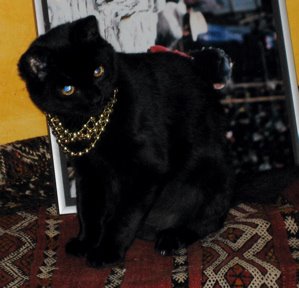
We've just learned that one of our kittens has a congenital defect in her spine that is already causing her great pain and will only get worse. Not good news.
Biologists distinguish those organisms that have many young, most of which aren't expected to survive (fish, rats, most insects, etc.) from those that have few young, but invest heavily in their survival (whales, humans, elephants, etc.). These two approaches to survival are known as r-type or K-type selection. As humans, we respond to the death of a child with profound grief. If we were r-type organisms, we would presumably be far more philosophical about such a death, as it would be an ever-present part of family life. So how does a K-type animal (Casi and me) respond to the demise of our r-type pet? It's a strange conundrum.
Cats are not known for their sensitivity to the death of others. They characteristically seem to enjoy the suffering of the mouse they play with for hours before killing. Death seems neither shocking nor unfamiliar to our feline friends. While Casi and I are heart-broken over watching this little kitten suffer and the need to end her suffering ourselves, she would probably not understand what all the fuss was about, if she were in our position. She'd probably consider us to be pathetically sentimental. We hide from ourselves the fact that we participate in death every day -- we call the dead cow, "beef" and the dead pig, "pork" to better obscure the reality from ourselves. And only this self-deception allows us to think that the death of a sick kitten is tragic.
Or so I keep telling myself...
Thursday, March 02, 2006
Cronkite on The War on Drugs
This was recently written by Walter Cronkite, perhaps the most respected journalist of the past 50 years.
As anchorman of the CBS Evening News, I signed off my nightly broadcasts for nearly two decades with a simple statement: "And that's the way it is."
To me, that encapsulates the newsman's highest ideal: to report the facts as he sees them, without regard for the consequences or controversy that may ensue.
Sadly, that is not an ethic to which all politicians aspire - least of all in a time of war.
I remember. I covered the Vietnam War. I remember the lies that were told, the lives that were lost - and the shock when, twenty years after the war ended, former Defense Secretary Robert S. McNamara admitted he knew it was a mistake all along.
Today, our nation is fighting two wars: one abroad and one at home. While the war in Iraq is in the headlines, the other war is still being fought on our own streets. Its casualties are the wasted lives of our own citizens.
I am speaking of the war on drugs.
And I cannot help but wonder how many more lives, and how much more money, will be wasted before another Robert McNamara admits what is plain for all to see: the war on drugs is a failure.
While the politicians stutter and stall - while they chase their losses by claiming we could win this war if only we committed more resources, jailed more people and knocked down more doors - the Drug Policy Alliance continues to tell the American people the truth - "the way it is."
I'm sure that's why you support DPA's mission to end the drug war. And why I strongly urge you to support their work by giving a generous donation today.
You see, I've learned first hand that the stakes just couldn't be higher.
When I wanted to understand the truth about the war on drugs, I took the same approach I did to the war in Vietnam: I hit the streets and reported the story myself. I sought out the people whose lives this war has affected.
Allow me to introduce you to some of them.
Nicole Richardson was 18-years-old when her boyfriend, Jeff, sold nine grams of LSD to undercover federal agents. She had nothing to do with the sale. There was no reason to believe she was involved in drug dealing in any way.
But then an agent posing as another dealer called and asked to speak with Jeff. Nicole replied that he wasn't home, but gave the man a number where she thought Jeff could be reached.
An innocent gesture? It sounds that way to me. But to federal prosecutors, simply giving out a phone number made Nicole Richardson part of a drug dealing conspiracy. Under draconian mandatory minimum sentences, she was sent to federal prison for ten years without possibility of parole.
To pile irony on top of injustice, her boyfriend - who actually knew something about dealing drugs - was able to trade information for a reduced sentence of five years. Precisely because she knew nothing, Nicole had nothing with which to barter.
Then there was Jan Warren, a single mother who lived in New Jersey with her teenage daughter. Pregnant, poor and desperate, Jan agreed to transport eight ounces of cocaine to a cousin in upstate New York. Police officers were waiting at the drop-off point, and Jan - five months pregnant and feeling ill - was cuffed and taken in.
Did she commit a crime? Sure. But what awaited Jan Warren defies common sense and compassion alike. Under New York's infamous Rockefeller Drug Laws, Jan - who miscarried soon after the arrest - was sentenced to 15 years to life. Her teenage daughter was sent away, and Jan was sent to an eight-by-eight cell.
In Tulia, Texas, an investigator fabricated evidence that sent more than one out of every ten of the town's African American residents to jail on trumped-up drug charges in one of the most despicable travesties of justice this reporter has ever seen.
The federal government has fought terminally ill patients whose doctors say medical marijuana could provide a modicum of relief from their suffering - as though a cancer patient who uses marijuana to relieve the wrenching nausea caused by chemotherapy is somehow a criminal who threatens the public.
People who do genuinely have a problem with drugs, meanwhile, are being imprisoned when what they really need is treatment.
And what is the impact of this policy?
It surely hasn't made our streets safer. Instead, we have locked up literally millions of people...disproportionately people of color...who have caused little or no harm to others - wasting resources that could be used for counter-terrorism, reducing violent crime, or catching white-collar criminals.
With police wielding unprecedented powers to invade privacy, tap phones and conduct searches seemingly at random, our civil liberties are in a very precarious condition.
Hundreds of billions of dollars have been spent on this effort - with no one held accountable for its failure.
Amid the clichés of the drug war, our country has lost sight of the scientific facts. Amid the frantic rhetoric of our leaders, we've become blind to reality: The war on drugs, as it is currently fought, is too expensive, and too inhumane.
But nothing will change until someone has the courage to stand up and say what so many politicians privately know: The war on drugs has failed.
That's where the Drug Policy Alliance comes in.
From Capitol Hill to statehouses to the media, DPA counters the hysteria of the drug war with thoughtful, accurate analysis about the true dangers of drugs, and by fighting for desperately needed on-the-ground reforms.
They are the ones who've played the lead role in making marijuana legally available for medical purposes in states across the country.
California's Proposition 36, the single biggest piece of sentencing reform in theUnited States since the repeal of Prohibition, is the result of their good work. The initiative is now in its fifth year, having diverted more than 125,000 people from prison and into treatment since its inception.
They oppose mandatory-minimum laws that force judges to send people like Nicole Richardson and Jan Warren to prison for years, with no regard for their character or the circumstances of their lives. And their work gets results: thanks in large part to DPA, New York has taken the first steps towards reforming the draconian Rockefeller Drug Laws under which Jan was sentenced.
In these and so many other ways, DPA is working to end the war on drugs and replace it with a new drug policy based on science, compassion, health and human rights.
DPA is a leading, mainstream, respected and effective organization that gets real results.
But they can't do it alone.
That's why I urge you to send as generous a contribution as you possibly can to the Drug Policy Alliance.
Americans are paying too high a price in lives and liberty for a failing war on drugs about which our leaders have lost all sense of proportion. The Drug Policy Alliance is the one organization telling the truth. They need you with them every step of the way.
And that's the way it is.
Make a Donation
As anchorman of the CBS Evening News, I signed off my nightly broadcasts for nearly two decades with a simple statement: "And that's the way it is."
To me, that encapsulates the newsman's highest ideal: to report the facts as he sees them, without regard for the consequences or controversy that may ensue.
Sadly, that is not an ethic to which all politicians aspire - least of all in a time of war.
I remember. I covered the Vietnam War. I remember the lies that were told, the lives that were lost - and the shock when, twenty years after the war ended, former Defense Secretary Robert S. McNamara admitted he knew it was a mistake all along.
Today, our nation is fighting two wars: one abroad and one at home. While the war in Iraq is in the headlines, the other war is still being fought on our own streets. Its casualties are the wasted lives of our own citizens.
I am speaking of the war on drugs.
And I cannot help but wonder how many more lives, and how much more money, will be wasted before another Robert McNamara admits what is plain for all to see: the war on drugs is a failure.
While the politicians stutter and stall - while they chase their losses by claiming we could win this war if only we committed more resources, jailed more people and knocked down more doors - the Drug Policy Alliance continues to tell the American people the truth - "the way it is."
I'm sure that's why you support DPA's mission to end the drug war. And why I strongly urge you to support their work by giving a generous donation today.
You see, I've learned first hand that the stakes just couldn't be higher.
When I wanted to understand the truth about the war on drugs, I took the same approach I did to the war in Vietnam: I hit the streets and reported the story myself. I sought out the people whose lives this war has affected.
Allow me to introduce you to some of them.
Nicole Richardson was 18-years-old when her boyfriend, Jeff, sold nine grams of LSD to undercover federal agents. She had nothing to do with the sale. There was no reason to believe she was involved in drug dealing in any way.
But then an agent posing as another dealer called and asked to speak with Jeff. Nicole replied that he wasn't home, but gave the man a number where she thought Jeff could be reached.
An innocent gesture? It sounds that way to me. But to federal prosecutors, simply giving out a phone number made Nicole Richardson part of a drug dealing conspiracy. Under draconian mandatory minimum sentences, she was sent to federal prison for ten years without possibility of parole.
To pile irony on top of injustice, her boyfriend - who actually knew something about dealing drugs - was able to trade information for a reduced sentence of five years. Precisely because she knew nothing, Nicole had nothing with which to barter.
Then there was Jan Warren, a single mother who lived in New Jersey with her teenage daughter. Pregnant, poor and desperate, Jan agreed to transport eight ounces of cocaine to a cousin in upstate New York. Police officers were waiting at the drop-off point, and Jan - five months pregnant and feeling ill - was cuffed and taken in.
Did she commit a crime? Sure. But what awaited Jan Warren defies common sense and compassion alike. Under New York's infamous Rockefeller Drug Laws, Jan - who miscarried soon after the arrest - was sentenced to 15 years to life. Her teenage daughter was sent away, and Jan was sent to an eight-by-eight cell.
In Tulia, Texas, an investigator fabricated evidence that sent more than one out of every ten of the town's African American residents to jail on trumped-up drug charges in one of the most despicable travesties of justice this reporter has ever seen.
The federal government has fought terminally ill patients whose doctors say medical marijuana could provide a modicum of relief from their suffering - as though a cancer patient who uses marijuana to relieve the wrenching nausea caused by chemotherapy is somehow a criminal who threatens the public.
People who do genuinely have a problem with drugs, meanwhile, are being imprisoned when what they really need is treatment.
And what is the impact of this policy?
It surely hasn't made our streets safer. Instead, we have locked up literally millions of people...disproportionately people of color...who have caused little or no harm to others - wasting resources that could be used for counter-terrorism, reducing violent crime, or catching white-collar criminals.
With police wielding unprecedented powers to invade privacy, tap phones and conduct searches seemingly at random, our civil liberties are in a very precarious condition.
Hundreds of billions of dollars have been spent on this effort - with no one held accountable for its failure.
Amid the clichés of the drug war, our country has lost sight of the scientific facts. Amid the frantic rhetoric of our leaders, we've become blind to reality: The war on drugs, as it is currently fought, is too expensive, and too inhumane.
But nothing will change until someone has the courage to stand up and say what so many politicians privately know: The war on drugs has failed.
That's where the Drug Policy Alliance comes in.
From Capitol Hill to statehouses to the media, DPA counters the hysteria of the drug war with thoughtful, accurate analysis about the true dangers of drugs, and by fighting for desperately needed on-the-ground reforms.
They are the ones who've played the lead role in making marijuana legally available for medical purposes in states across the country.
California's Proposition 36, the single biggest piece of sentencing reform in theUnited States since the repeal of Prohibition, is the result of their good work. The initiative is now in its fifth year, having diverted more than 125,000 people from prison and into treatment since its inception.
They oppose mandatory-minimum laws that force judges to send people like Nicole Richardson and Jan Warren to prison for years, with no regard for their character or the circumstances of their lives. And their work gets results: thanks in large part to DPA, New York has taken the first steps towards reforming the draconian Rockefeller Drug Laws under which Jan was sentenced.
In these and so many other ways, DPA is working to end the war on drugs and replace it with a new drug policy based on science, compassion, health and human rights.
DPA is a leading, mainstream, respected and effective organization that gets real results.
But they can't do it alone.
That's why I urge you to send as generous a contribution as you possibly can to the Drug Policy Alliance.
Americans are paying too high a price in lives and liberty for a failing war on drugs about which our leaders have lost all sense of proportion. The Drug Policy Alliance is the one organization telling the truth. They need you with them every step of the way.
And that's the way it is.
Make a Donation
Subscribe to:
Comments (Atom)